


Under the USAID funded Marketing Innovations for Sustainable Health Development (MISHD), SMC is implementing an innovative Community Mobilization Program named Notun Din through three implementing partner NGOs in 62 upazilas under 16 districts. The program partners are- CWFD, PSTC and Shimantik. Among the partners, Shimantik is implementing Notun Din program in total 28 upazilas of 5 districts in Sylhet region where 4 districts of Sylhet division (Habiganj, Moulvibazar, Sunamganj and Sylhet) and one district under Chittagong division (B.Baria). CWFD is implementing in total 6 districts-3 district of Barisal division (Barisal, Jhalokati, Perojpur) 2 districts of Dhaka division (Faridpur, Madaripur) and one district of Chittagong division (Chadpur). PSTC is implementing in 5 districts under 2 divisions where 3 districts (Kishoreganj,Munshiganj, Narsingdi) of Dhaka division and other 2 districts in Chittagong division (Laxmipur, Noakhali). The Notun Din program has two components- one is the community mobilization through using various tools and materials for the behavior change towards adaption of healthy practices and distribution of health and family planning products through rural women entrepreneurs called Community Sales Agents (CSAs). Currently, there is total 2374 Community Sales Agents (CSAs) are engaged in the whole intervention area.
Inspiration from MIH project SMC expanded the community Mobilization program with its own fund in 3 upazilas of Natore district where the upazilas are - Boraigram, Gurudaspur & Lalpur. In that area the program modalities are same where also selected and developed the 92 Community Sales Agent(CSA). This project has been implementing by a local level partner organization- SACHETAN.
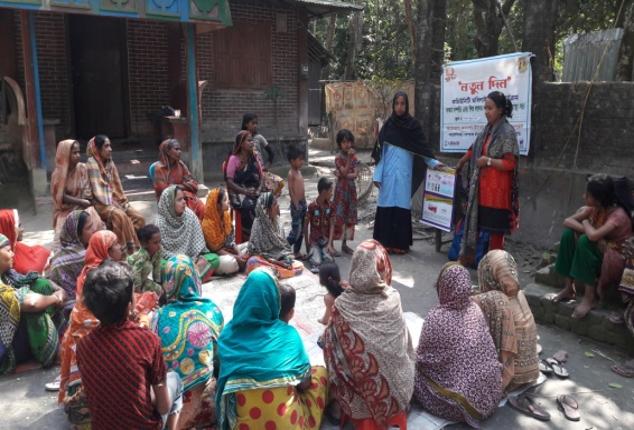
Through this program, core communication messages on 5 health packages are disseminated to mostly rural women, men and adolescents in the 17 priority districts. The information packages contain messages on Healthy Timing & Spacing of Pregnancy (HTSP), The First 1,000 Days Care of a Child (pregnancy to 2 years), Adolescent Reproductive Health and TB Prevention and Referrals. For reaching out to the target population with the messages, SMC has introduced an innovative approach of conducting group sessions. Unlike traditional ways of only verbal discussion on the issues, audio-based folk song (Palagaan) is played in these sessions with pictorial aid to assure audience’s better entertainment and easy understanding. Below are the type of meetings and Interpersonal communication (IPC) sessions that Notun Din organizes to reach the target populations.
Activities under the‘Notun Din’Community Mobilization Program:
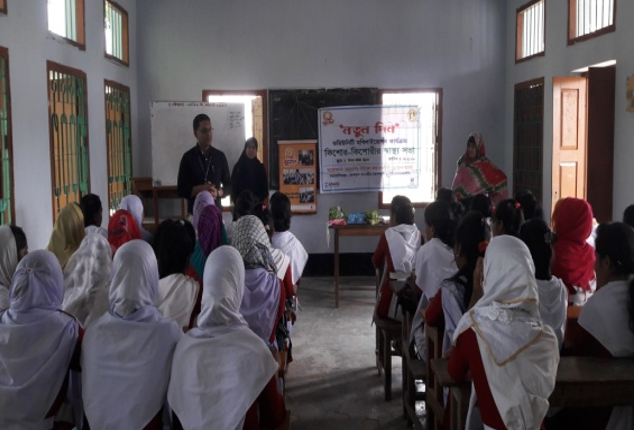
a. Advocacy meetings to generate supports for the program at the community level
b. Group meetings with MWRAs and Caregivers of children < 5 on HTSP and the First 1000 Days Care
c. IPC with Newlywed couple about Family Planning issues.
d. Information dissemination to Marriage registers to protect Early Marriage.
e. School Health Program to reach students with adolescent health message.
f. Four core health packages are disseminated through Mobile Flim Program (MFP) to the community peoples.
g. Through Floating IEC four core health packages are disseminated to hard to reach riverine areas populations.
Community Sales Agents Program
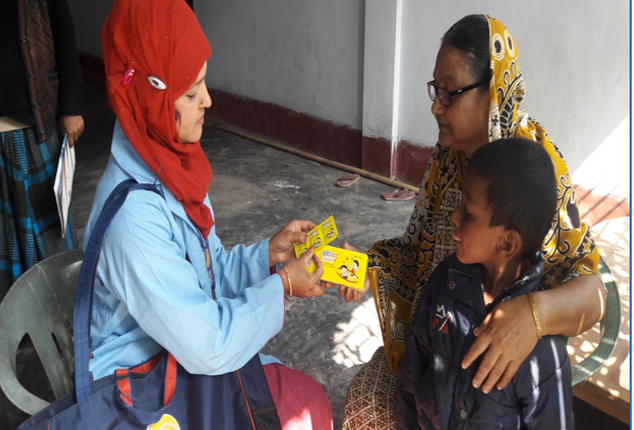
Community Sales Agents (CSAs) activities is one of the critical interventions of Notun Din Program. CSAs are women entrepreneurs selected from rural communities where they visit the households to disseminate public health information and sell SMC’s public health products. Their product basket include different brands of condom and oral pill, emergency contraceptive pill, ORS, zinc, sanitary napkin, safe delivery kit, micronutrient powder, instant soft drink powder and pregnancy test kit of SMC. In addition, they provide technical assistance for pregnancy test to the respective women including supply of pregnancy test device. As part of the program, Community Sales Agents (CSAs) are engaged to sell SMC health and family planning products to households within an agent’s catchment area. This gives rural women an opportunity to earn profit margins on the sales they make. This idea of creating local level entrepreneurs was developed largely by SMC which is committed to sustain the supply of commodities to these agents far beyond the life of the MISHD project and help these women become role models for many others in the community. CSAs also promote essential health messages of the program and provide support to organize various community level events like mobile film program, day observation, school health and hygiene sessions and outreach program of Floating IEC Center.
CSAs are permanent resident in their communities, have minimum eight grade education, willing to visit household to disseminate health information, sale products and are interested to be entrepreneur. CSAs purchase products in cash when they come to upazila office once a month and sell it throughout the month. SMC does not pay any honorarium to the CSAs rather they earn the profit margin between trade and maximum retail price of the products. Currently, more than 2,300 CSAs have been engaged with the Notun Din program through the 3 partner NGOs. After selection of CSAs, SMC provides basic and periodical refresher trainings for them to build their capacity in disseminating health information and increase their sales skills. Necessary logistics such as branded dress, product storage container, bag, apron, umbrella, signboards, identity card etc. are provided to promote and facilitate their sales.
Mobile Audio Visual Program
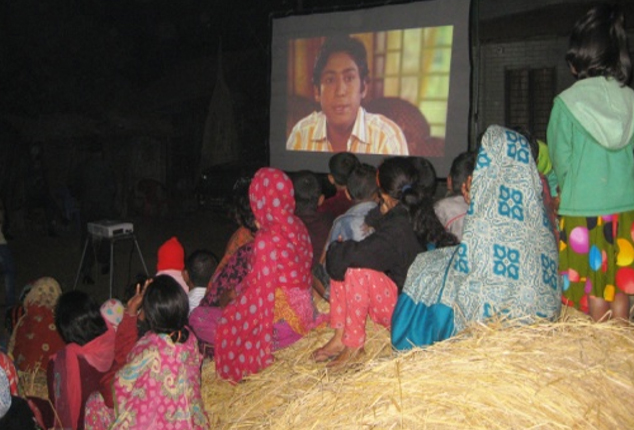
As a part of the strategy to strengthen mobilization efforts, SMC has currently engaged 4 Mobile Film Units in the MISHD intervention upazilas. SMC is using this popular media channel to reach people in remote and media- dark areas to reinforce community mobilization activities with short films on the MISHD core communication packages. The Notun Din partners field level staff and CSAs provide support for selecting the need based program venue and organization of shows in the evening. In the MAVP show, 2-3 dramas namely Rangila Bao, Notun Din-er Golpo, Notun Din-er Alo with some relevant TVCs are shown.
BCC campaign on LAPM
BCC campaign on LAPM services in Korail slum- evidence based result for program intervention
According to the Bangladesh Demographic and Health Survey 2014 and Urban Health Survey 2010, the use of modern method is higher at urban slum than the national figure. But the use of Long Acting and Permanent Method (LAPM) is low among the urban slum people than others. The use of LAPM in last 10 years remained almost stagnant and increased only from 7.2% to 8.1%. On the other hand, majority women complete their family size at early age and continue to rely on temporary method for rest of their reproductive life cycle which is causing unintended pregnancies in many cases.
Therefore, SMC operated a BCC related pilot program in 2016 using own resources at Karail Slum of Dhaka City with an aim to increase knowledge and use of LAPM. The result of pilot initiative was quite satisfactory and therefore SMC Board decided to expand this initiative in untapped area of Korail Slum and Sattola Slum, started from January 2018. Total seven staffs performed 140 LAPM services during the period of January- April 2018. The campaign will continue upto December 2018. The effects of intervention will be done through an endline evaluation.
Floating IEC Program
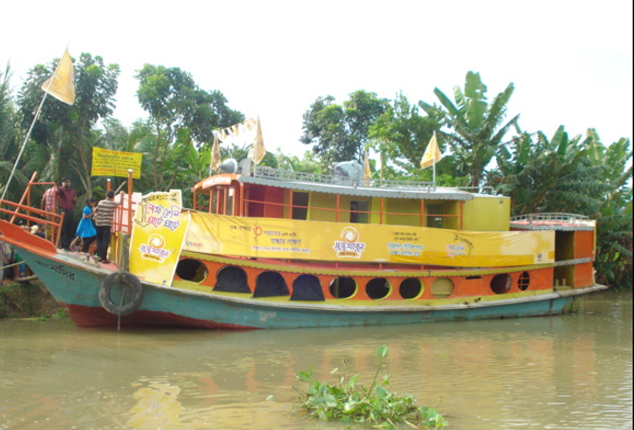
Floating IEC Program is one of the most important innovative activities under the USAID funded ‘Notun Din’ MIH program. SMC has been implemented this program since 2009 at hard-to-reach reverine population of with ‘Floating IEC Center’ generated huge interest among the audience.
Under the `Notun Din’ program, the TB program of SMC endeavors to create a bridge between the major stakeholders in TB prevention, diagnosis and cure including the general population, private practitioners, the National TB Control Program and Govt. and NGO service delivery centers. In addition, three short dramas on HTSP, First 1000 Days Care and
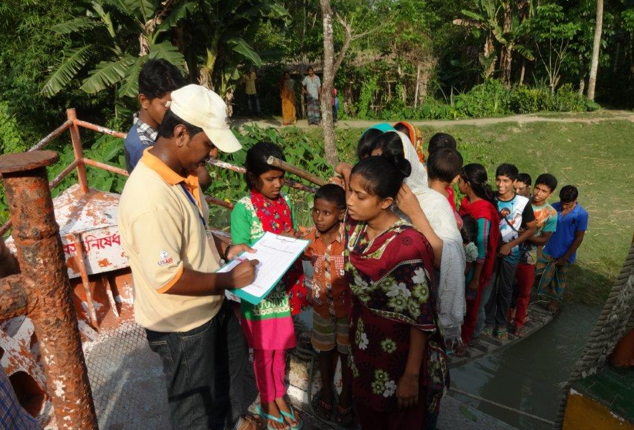
Adolescents Health are being included in the show since 2013. A Floating IEC center reaches the pre-scheduled harbor of the riverine areas as part of its daily activities. People get into the launch after registration and sit in the gallery. Then a power point presentation performs consisting messages on TB diagnosis, referral and treatment. Next, an inter-educative drama on TB projects and finally a quiz session is carried out. Quiz winners are rewarded with small materials such as thermometer, key ring, hand fan etc. as well. Booklet and Stickers are also distributed to the audience aiming to dissemination and retention messages. Sometimes outdoor sessions are also conducted depending on the demand of the local people.
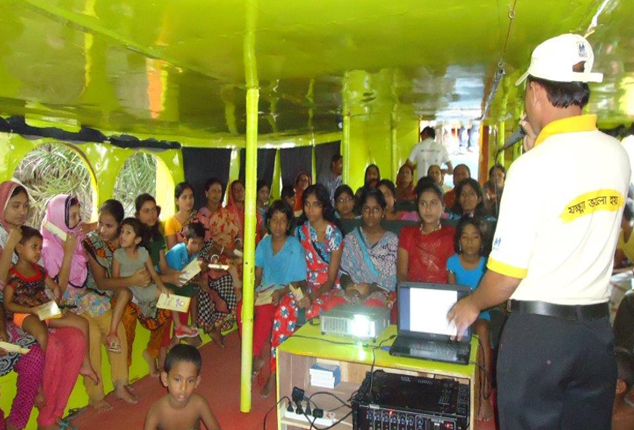
The existing Floating IEC launch is conducting shows through travelled in the intervention upazilas of Pirojpur, Jhalokati, Barisal, Madaripur and Faridpur districts. It will also cover in the riverine areas of the 4 upazilas in Chandpur district.